En🇺🇸
Pt🇧🇷↓
Researching was interesting for me since I've started a renewed love for lambada. Below a summary from the research on this commonly told story.
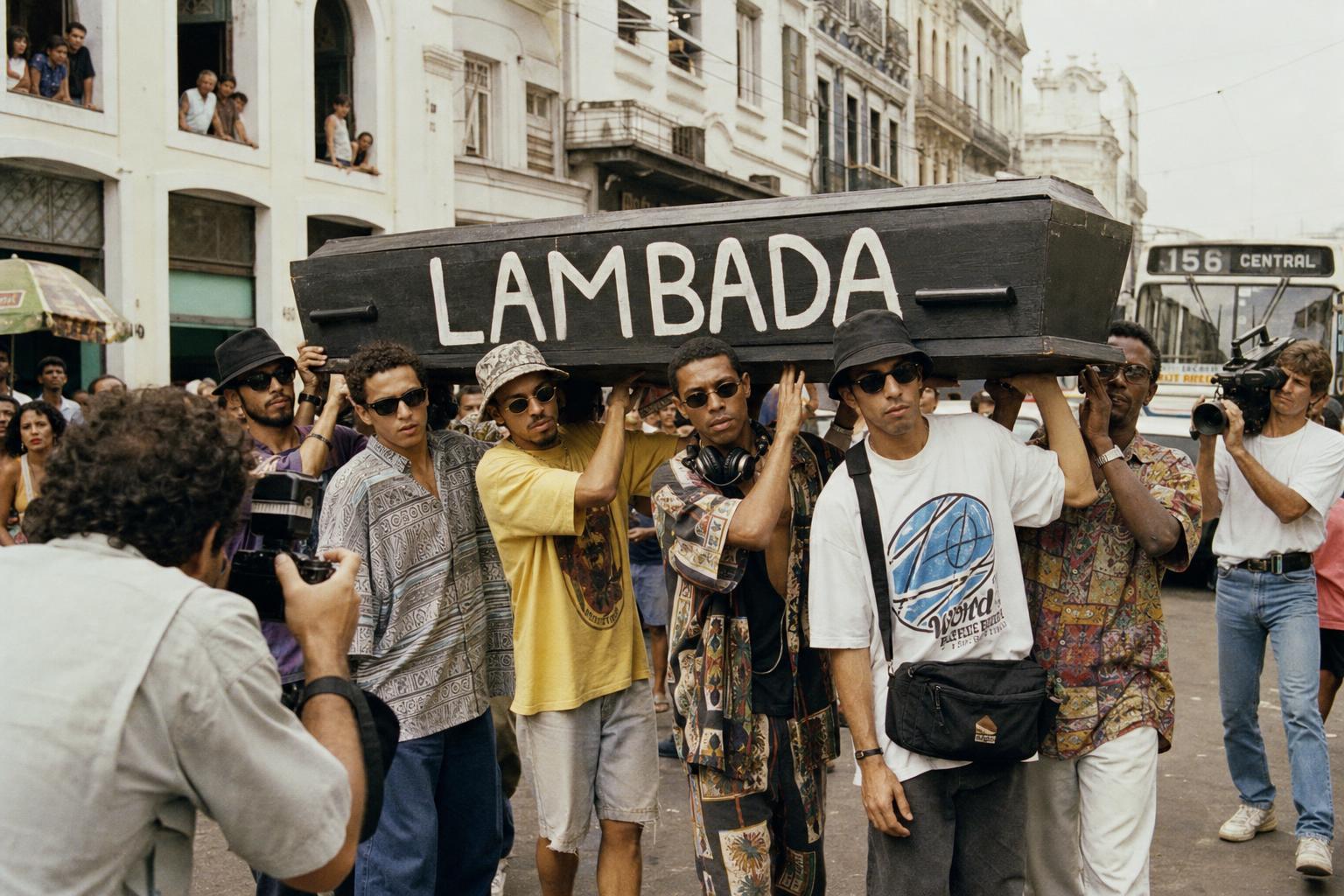
Somewhere in downtown Rio, around 1992, a group of club DJs carried a coffin through the street.
The word on the side was LAMBADA.
Almost nothing else about that afternoon is agreed on.
Jaime Arôxa, the Rio master who carried the dance from the Bahian coast into the studio, told it this way in a recorded talk published in 2018: "they built a funeral coffin, wrote 'lambada' on it, and ran it through the city. Everyone filmed it, and the next day it was in the newspapers: lambada died."
Renata Peçanha, who was dancing lambada at Rio parties that year, has told it at least four times on camera. To The Zoukline in 2023 it was one coffin with LAMBADA painted on it, marched through downtown, "a protest that ran on the main TV news." To the ZoukMX teachers' course in 2022 it was plural: "They went to the streets carrying coffins." And then, because the room looked doubtful: "it was on TV, on Globo, the main channel of Brazil."
Gert Faber, who compiled the founders' accounts into a history lecture in Amsterdam in 2020, has the coffin reading "Lambada is dead".
One coffin or several. The papers the next morning or the evening news. "Lambada" or "Lambada is dead".
That is what an oral history looks like thirty-four years on. Everyone remembers the coffin. Nobody we have read names a single DJ, gives the date, or points to a photograph.
Why DJs?
Because lambada had taken their rooms. Renata put it plainly at the White House Kizomba and Zouk Summit in Washington in 2016: "The DJs from the clubs that played house, electronic, they were terrified by lambada, because lambada destroyed them, simply. Everybody wanted to dance lambada; nobody wanted to listen to electronic."
Arôxa's version is the same story from the booth. Rio's nightclubs filled with lambada and stopped playing electronic music, and the DJs revolted.
Renata again, in 2022: "The DJs who worked with dance music were forced to play lambada, because nobody wanted anything else. They lost their jobs a little, and they wanted them back."
And it was not one march. In the BZDC's official history video in 2015 she calls it a movement to boycott lambada. In Washington she said the DJs "started advertising, and boycotting." A campaign, with a funeral as its press event.
"The death of a thing that is cultural," she told The Zoukline. "Insane."
The coffin was the loud part.
The quiet part was happening in classrooms.
Lambada, as it arrived from Porto Seguro, was danced on the spot, hips first, at a speed that punished anyone who was not young. Renata in the BZDC video: "It was common for an academy class to begin with fifty students and shrink by the second month, simply because the movements were so fast and so physical."
Gui Prada, who interviewed the founders for hours before giving his own history talk, heard a steeper curve: classes opening with seventy or ninety people in the hype and down to ten or fifteen within three weeks.
Different numbers. Same shape.
In Washington, Renata said what the numbers meant for a teacher: "People entered a lambada class and gave up: too fast, too difficult, too much hip movement from the very first basic. Imagine the boys."
Then there were the other enemies, the ones who never bought a coffin.
The church. Gilson Damasco, who started dancing in São Paulo around 1989, remembers what people said: "no, no, don't dance lambada, you don't go to heaven if you dance that."
The films. Producers in the craze years made erotic movies around the dance, including, Renata notes, one literally titled Lambada: A Dança Proibida. "Imagine what's inside. Associating lambada with sex." In Washington she described the damage in one sentence: "a husband or wife sees lambada and says, 'I will not allow you to dance with another guy'".
And the record business. Rodrigo Delano, who was eleven when lambada hit the floors and later helped name what came after, told us in 2015 that the fever lasted about four years, that Kaoma stopped producing the music, and that axé became the new craze with television behind it. Renata, in 2022: "at some point they stop producing, and the thing goes weaker."
So what killed lambada?
A boycott. A basic step too hard for anyone who was not young. A sermon. An erotic film. A label that moved on. Every witness ranks them differently, and every witness is probably right about their own corner of it. The honest version is Renata's: "As it went up very quickly, it went down very fast."
For Arôxa, the man who had built a syllabus around it, the funeral was personal.
"And lambada died. I was very sad, very revolted. I said: I don't want to work with this anymore."
He turned to the two best dancers he had, Adílio Porto and Renata Peçanha, and handed them everything: "Continue. Continue for me. I'm going back to tango, back to samba. The didactics are ready." Then, in his telling, the name changed by itself: "That's when zouk was really born."
Here the dates stop fitting, and we are not going to pretend they do.
Renata dates the funeral to around 1992. She also says she entered Arôxa's school in 1993 and married Adílio in 1996, and Arôxa describes the two of them as a couple at the time of the handover. So either the march came later than anyone remembers, or the handover came well after the march, or a master telling the story thirty years on folded two or three years into one speech. The sources cannot settle it. We would rather show you the seam than sand it down.
What is not in doubt is what the dancers did next.
No new lambada was being recorded. In the late-eighties dance halls, Delano says, DJs had played mostly lambada with roughly ten percent zouk and ten percent gypsy music mixed in. When the lambada ran out, they reached for what was already in the crate. Renata remembers the party DJs stretching their sets with Gypsy Kings, whose rumba fit the timing, and with the fast early Caribbean zouk they had always sprinkled in.
And the teachers changed the sign on the door. Faber heard it from several of them: they used the name zouk for the dance "so they could dance undercover and teach undercover to be able to continue." Rodrigo Delano, in the second half of the same 2018 talk, saw it from the schools' side: "If my school offers a lambada class, no students; zouk is full."
Even the birthplace went quiet. Gilson, who kept a circuit between Buenos Aires, São Paulo, Rio and Bahia through those years, remembers: "in 1994, '95, '96, when you went to Porto Seguro, you had to ask the DJs: please, could you play some lambada, or some zouk?" His verdict: "The lambada almost disappeared from Porto Seguro."
Almost.
Renata refuses the word the DJs chose. In 2022: "It didn't die. But it went weaker." On The Zoukline: lambada survives to this day, "but people wanted to kill lambada."
So here is where the story leaves us. A coffin with a word on it, carried by people who wanted their Saturday nights back. A dance that climbed out under a borrowed name, slowed down, learned to travel forward and back, and met most of us decades later as Brazilian zouk.
Who were the DJs? Which street? Which newspaper ran the photo the next morning?
Nobody we have read can say. If you were in downtown Rio that day, or you kept the clipping, we want to hear from you. The archive has a coffin-shaped hole in it, and only the people who were there can fill it.
Pt🇧🇷
Em algum lugar do centro do Rio, por volta de 1992, um grupo de DJs de boate carregou um caixão pela rua.
A palavra escrita na lateral era LAMBADA.
Quase nada mais daquela tarde é consenso.
Jaime Arôxa, o mestre carioca que levou a dança do litoral baiano para dentro do estúdio, contou assim em uma palestra gravada e publicada em 2018: eles construíram um caixão de enterro, escreveram "lambada" nele e saíram correndo com ele pela cidade. Todo mundo filmou, e no dia seguinte estava nos jornais: a lambada morreu.
Renata Peçanha, que naquele ano dançava lambada nas festas do Rio, já contou a cena pelo menos quatro vezes diante de uma câmera. Para o The Zoukline, em 2023, era um caixão com LAMBADA pintado, levado em marcha pelo centro, um protesto que foi parar no principal telejornal. Para o curso de professores do ZoukMX, em 2022, era no plural: eles foram para as ruas carregando caixões. E então, porque a sala pareceu desconfiar: passou na TV, na Globo, o principal canal do Brasil.
Gert Faber, que em 2020 reuniu os relatos dos fundadores em uma palestra de história em Amsterdã, lembra do caixão com os dizeres "a lambada morreu".
Um caixão ou vários. O jornal da manhã seguinte ou o telejornal da noite. "Lambada" ou "a lambada morreu".
É assim que uma história oral se parece trinta e quatro anos depois. Todo mundo lembra do caixão. Ninguém que nós lemos cita o nome de um único DJ, dá a data ou aponta uma fotografia.
Por que os DJs?
Porque a lambada tinha tomado as pistas deles. Renata foi direta no White House Kizomba and Zouk Summit, em Washington, em 2016: os DJs das boates que tocavam house, eletrônico, ficaram aterrorizados com a lambada, porque a lambada simplesmente os destruiu. Todo mundo queria dançar lambada; ninguém queria ouvir eletrônico.
A versão de Arôxa é a mesma história vista da cabine. As boates do Rio se encheram de lambada e pararam de tocar música eletrônica, e os DJs se revoltaram.
Renata de novo, em 2022: os DJs que trabalhavam com dance music foram obrigados a tocar lambada, porque ninguém queria outra coisa. Perderam um pouco o emprego, e queriam o emprego de volta.
E não foi uma marcha só. No vídeo oficial de história do BZDC, em 2015, ela chama aquilo de um movimento de boicote à lambada. Em Washington, disse que os DJs começaram a anunciar, e a boicotar. Uma campanha, com um enterro como evento de imprensa.
"A morte de uma coisa que é cultural", ela disse ao The Zoukline. "Insano."
O caixão foi a parte barulhenta.
A parte silenciosa estava acontecendo nas salas de aula.
A lambada, do jeito que chegou de Porto Seguro, era dançada no lugar, quadril primeiro, numa velocidade que castigava quem não fosse jovem. Renata, no vídeo do BZDC: era comum uma turma de academia começar com cinquenta alunos e encolher até o segundo mês, simplesmente porque os movimentos eram rápidos e físicos demais.
Gui Prada, que entrevistou os fundadores por horas antes de dar sua própria palestra de história, ouviu uma curva ainda mais íngreme: turmas que abriam com setenta ou noventa pessoas no auge do hype e caíam para dez ou quinze em três semanas.
Números diferentes. Mesma forma.
Em Washington, Renata disse o que esses números significavam para um professor: as pessoas entravam numa aula de lambada e desistiam. Rápido demais, difícil demais, quadril demais desde o primeiro básico. "Imagine os meninos."
Depois vieram os outros inimigos, os que nunca compraram caixão.
A igreja. Gilson Damasco, que começou a dançar em São Paulo por volta de 1989, lembra do que as pessoas diziam: não, não, não dance lambada, você não vai para o céu se dançar isso.
Os filmes. Na época da febre, produtores fizeram filmes eróticos em torno da dança, incluindo, Renata lembra, um literalmente chamado Lambada: A Dança Proibida. "Imagine o que tem dentro. Associar a lambada com sexo." Em Washington, ela descreveu o estrago em uma frase: um marido ou uma esposa vê a lambada e diz "eu não vou permitir que você dance com outro cara".
E a indústria do disco. Rodrigo Delano, que tinha onze anos quando a lambada tomou as pistas e mais tarde ajudou a dar nome ao que veio depois, nos contou em 2015 que a febre durou uns quatro anos, que o Kaoma parou de produzir a música e que o axé virou a nova moda, com a televisão por trás. Renata, em 2022: em algum momento eles param de produzir, e a coisa enfraquece.
Então, o que matou a lambada?
Um boicote. Um passo básico difícil demais para quem não era jovem. Um sermão. Um filme erótico. Uma gravadora que seguiu em frente. Cada testemunha coloca essas causas em uma ordem diferente, e cada uma provavelmente tem razão sobre o seu pedaço. A versão honesta é a de Renata: subiu muito rápido, e desceu muito rápido.
Para Arôxa, o homem que tinha construído um método em volta daquilo, o enterro foi pessoal.
E a lambada morreu. Eu fiquei muito triste, muito revoltado. Eu disse: não quero mais trabalhar com isso.
Ele se virou para os dois melhores bailarinos que tinha, Adílio Porto e Renata Peçanha, e entregou tudo: continuem. Continuem por mim. Eu vou voltar para o tango, para o samba. A didática está pronta. E então, no relato dele, o nome mudou sozinho: foi aí que o zouk nasceu de verdade.
Aqui as datas param de encaixar, e nós não vamos fingir que encaixam.
Renata situa o enterro por volta de 1992. Ela também diz que entrou na escola de Arôxa em 1993 e se casou com Adílio em 1996, e Arôxa descreve os dois como um casal na época da passagem de bastão. Então ou a marcha foi mais tarde do que todo mundo lembra, ou a passagem veio bem depois da marcha, ou um mestre contando a história trinta anos depois dobrou dois ou três anos em um único discurso. As fontes não resolvem isso. Preferimos mostrar a costura a fingir que ela não existe.
O que não está em dúvida é o que os dançarinos fizeram em seguida.
Nenhuma lambada nova estava sendo gravada. Nos salões do fim dos anos oitenta, diz Delano, os DJs tocavam principalmente lambada com uns dez por cento de zouk e dez por cento de música cigana no meio. Quando a lambada acabou, eles pegaram o que já estava na caixa de discos. Renata lembra dos DJs de festa esticando os sets com Gypsy Kings, cuja rumba cabia no tempo, e com aquele zouk caribenho rápido do começo que eles sempre tinham salpicado.
E os professores trocaram a placa da porta. Faber ouviu de vários deles: passaram a usar o nome zouk para a dança, para poder dançar disfarçados e ensinar disfarçados e conseguir continuar. Rodrigo Delano, na segunda metade da mesma palestra de 2018, viu isso do lado das escolas: se a minha escola oferece uma aula de lambada, não tem aluno; a de zouk fica cheia.
Até o lugar de origem ficou quieto. Gilson, que naqueles anos manteve um circuito entre Buenos Aires, São Paulo, Rio e Bahia, lembra: em 1994, 95, 96, quando você ia a Porto Seguro, tinha que pedir aos DJs: por favor, dá para tocar uma lambada, ou um zouk? O veredito dele: a lambada quase desapareceu de Porto Seguro.
Quase.
Renata recusa a palavra que os DJs escolheram. Em 2022: não morreu. Mas enfraqueceu. No The Zoukline: a lambada sobrevive até hoje, mas as pessoas queriam matar a lambada.
Então é aqui que a história nos deixa. Um caixão com uma palavra escrita, carregado por gente que queria suas noites de sábado de volta. Uma dança que saiu de lá com nome emprestado, desacelerou, aprendeu a andar para frente e para trás e encontrou a maioria de nós décadas depois como zouk brasileiro.
Quem eram os DJs? Que rua? Que jornal publicou a foto na manhã seguinte?
Ninguém que nós lemos sabe dizer. Se você estava no centro do Rio naquele dia, ou guardou o recorte, queremos ouvir você. O arquivo tem um buraco no formato de caixão, e só quem estava lá pode preencher.
Comments
Loading comments…
You'll be asked to sign in before posting — we'll keep your draft.