
En🇺🇸Es🇨🇴↓
I have to start with a confession: I’m in the Zouk16 at Colombia Secret. I’m number eight.
So, clearly, I’m not the most objective person to talk to you about this.
But precisely because of that, I wanted to tell you why I like this format so much and why I think it’s worth watching and, if you’re taking part in the Bracket Challenge, trying to guess who’s going to win.
If you’ve never seen a Zouk16 before, let me quickly explain how it works.
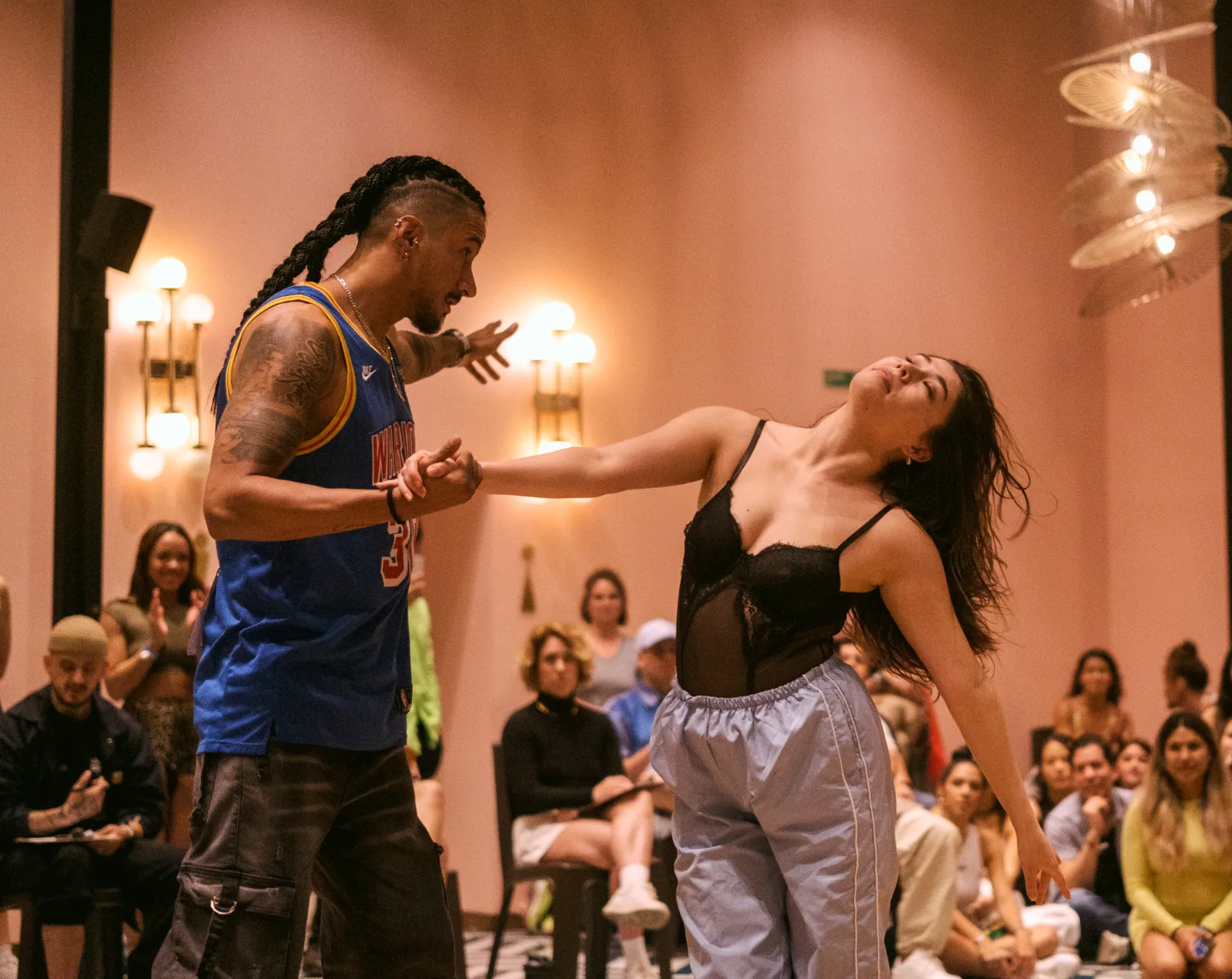
Sixteen professionals take part in the tournament. Each one dances with a student who is randomly selected from the Jack & Jill happening earlier that same weekend. The professional doesn’t choose their partner, and the student doesn’t choose either. They meet, get on the floor, and have to dance together.
Two couples compete at the same time: one on the blue side and one on the red side. A song plays and, when it ends, five judges raise a paddle to decide which couple moves on to the next round.
And here’s one of the things I like most about the format: there are far fewer rules than in a traditional Jack & Jill.
There isn’t a list of moves you can or can’t do. The format gives you much more freedom to play with the music and the space. You can do lifts, floor work, bigger movements, more theatrical or creative things that you normally wouldn’t have the same freedom to do in a Jack & Jill.
Obviously, this also makes the judges’ criteria even more important.
Because having more freedom doesn’t simply mean “do whatever you want.” The responsibility is to do something that still makes sense within the dance, keeps the Zouk hook, and works with the person you were paired with.
And for me, that’s one of the most interesting challenges of the Zouk16.
It’s not just about who can do the most impressive thing.
It’s about what you do with all that freedom.
And there’s another thing that makes this format quite different: it’s Pro-Am.
In a Jack & Jill, you’re normally competing with people who are within relatively similar level categories. Here, you’re not.
The professional and the student can be at completely different levels.
And that changes the experience quite a lot for both of them.
The professional has to adapt to someone they probably don’t know, with a different level and different tools from their own. And the student has to dance with someone who probably has much more experience, while also trying to make the most of the opportunity to show what they can do.
So you have a couple who can have a huge difference in experience, but still has to look like a couple during those few seconds that the song lasts.
And I think that’s really, really cool.
Because in the end, you have a format that combines a lot of creative freedom with an additional challenge: you don’t know who you’re going to dance with, and you don’t know exactly what’s going to happen once the music starts.
Now comes the part that I find even more interesting this year.
Besides the tournament itself, Colombia Secret has a Bracket Challenge.
There are sixteen professionals and fifteen matchups. Before the tournament starts, you can choose who you think will win each matchup and build your own bracket.
It’s free, and if you get all fifteen winners right, you win a lifetime pass to Colombia Secret.
Yes. A lifetime pass.
And here’s where my problem starts: how are we supposed to choose?
Last year, at ZoukMX, some pretty interesting things happened.
For example, some of the names that probably looked like favorites were eliminated in the first round. And the winner, Camilo Molina, was number eleven out of sixteen in followers.
I also looked at the first-round battles and found something interesting: choosing the professional who was leading worked in six out of eight battles.
But this year, I’m not sure that helps us much.
Because look at the first-round matchups.
Otavio Kaneshiro, number one, against Camilo, last year’s champion, who is seeded number sixteen.
Sara Bezerra against Laura Grigório, world champion.
Kevin Oliveira, Brazilian champion and the person with the most followers in the competition, against Camila Betancourt, one of the people who built the Zouk scene in Medellín.
And then there’s me against Juliana Tourres from Argentina, who teaches Zouk and Lambada.
My first dance was Argentine tango.
I want to believe that’s a sign.
You can decide if it is.
And that’s exactly why I like the Bracket Challenge.
Because we can try to use titles, experience, followers, nationality, what we’ve seen each person dance before… but in the end, nobody knows what’s going to happen when two couples step onto the floor.
And I think that’s part of what makes the Zouk16 so much fun.
It’s not just a competition about who dances better.
It’s a format that allows you to do things we don’t normally see in a Jack & Jill, with the added challenge of having to do it with someone you don’t know and who might be at a completely different level from you.
And five judges have to decide, in that moment, which of the two couples gave them more reasons to raise their paddle.
That leaves a lot of room for creativity.
And, inevitably, for interpretation.
So now I want to know what you think.
On the Bracket Challenge page, you can see all sixteen participants, learn a little more about each of them, and build your predictions.
And if you’ve already made your bracket, tell me:
Who did you pick in my battle?
I will find out anyway. 😉
Es🇨🇴
Tengo que empezar con una confesión: estoy en el Zouk16 de Colombia Secret. Soy la número ocho.
Así que, claramente, no soy la persona más objetiva para hablarles de esto.
Pero precisamente por eso quería contarles por qué me gusta tanto este formato y por qué creo que vale la pena verlo y, si están participando en el Bracket Challenge, intentar adivinar quién va a ganar.
Si nunca han visto un Zouk16, les explico rápidamente cómo funciona.
Dieciséis profesionales participan en el torneo. Cada uno baila con un estudiante que sale sorteado del Jack & Jill que se hace durante el mismo fin de semana. El profesional no elige a su pareja y el estudiante tampoco. Se conocen, salen a la pista y tienen que bailar juntos.
Dos parejas se enfrentan al mismo tiempo: una del lado azul y otra del lado rojo. Suena una canción y, cuando termina, cinco jueces levantan una paleta para decidir qué pareja pasa a la siguiente ronda.
Y aquí viene una de las cosas que más me gustan del formato: hay muchas menos reglas que en un Jack & Jill tradicional.
No hay una lista de movimientos que puedas o no puedas hacer. El formato permite mucha más libertad para jugar con la canción y con el espacio. Puedes hacer lifts, floor work, movimientos más grandes, cosas más teatrales o creativas que normalmente no tendrías la misma libertad de hacer en un Jack & Jill.
Obviamente, esto también hace que el criterio de los jueces sea todavía más importante.
Porque tener más libertad no significa simplemente “hacer lo que quieras”. La responsabilidad está en hacer algo que siga teniendo sentido dentro del baile, que conserve el hook del Zouk y que funcione con la persona con la que te tocó bailar.
Y para mí, ahí está uno de los retos más interesantes del Zouk16.
No se trata solamente de quién puede hacer la cosa más impresionante.
Se trata de lo que haces con toda esa libertad.
Y hay otra cosa que hace que este formato sea bastante diferente: es Pro-Am.
En un Jack & Jill normalmente estás compitiendo con personas que están dentro de categorías relativamente similares de nivel. Aquí no.
El profesional y el estudiante pueden estar en niveles completamente diferentes.
Y eso cambia muchísimo la experiencia para los dos.
El profesional tiene que adaptarse a una persona que probablemente no conoce, con un nivel y unas herramientas diferentes a las suyas. Y el estudiante tiene que bailar con alguien que probablemente tiene mucha más experiencia, mientras además intenta aprovechar la oportunidad de mostrar lo que puede hacer.
Entonces tienes una pareja que puede tener una diferencia enorme de experiencia, pero que tiene que verse como una pareja durante esos segundos que dura la canción.
Y eso me parece muy, muy chévere.
Porque al final tienes un formato que combina bastante libertad creativa con una dificultad adicional: no sabes con quién vas a bailar y no sabes exactamente qué va a pasar cuando empiece la música.
Ahora viene la parte que me interesa todavía más este año.
Además del torneo, Colombia Secret tiene un Bracket Challenge.
Hay dieciséis profesionales y quince enfrentamientos. Antes de que empiece el torneo, ustedes pueden escoger quién creen que va a ganar cada enfrentamiento y construir su propio bracket.
Es gratis, y si aciertan los quince ganadores, se llevan un pase de por vida a Colombia Secret.
Sí. De por vida.
Y aquí es donde empieza mi problema: ¿cómo se supone que escogemos?
El año pasado, en ZoukMX, hubo algunas cosas bastante interesantes.
Por ejemplo, algunos de los nombres que probablemente parecían favoritos quedaron eliminados en la primera ronda. Y el ganador, Camilo Molina, estaba número once de dieciséis en seguidores.
También miré las primeras rondas y encontré algo curioso: escoger al profesional que lideraba funcionó en seis de las ocho batallas.
Pero este año no sé si nos sirve de mucho.
Porque miren los enfrentamientos de la primera ronda.
Otavio Kaneshiro, número uno, contra Camilo, el campeón del año pasado, que está sembrado como número dieciséis.
Sara Bezerra contra Laura Grigório, campeona mundial.
Kevin Oliveira, campeón brasileño y la persona con más seguidores de la competencia, contra Camila Betancourt, una de las personas que construyó la escena de Zouk en Medellín.
Y después estoy yo contra Juliana Tourres, de Argentina, que enseña Zouk y Lambada.
Mi primer baile fue el tango argentino.
Yo quiero pensar que eso es una señal.
Ustedes pueden decidir si lo es.
Y justamente por eso me gusta el Bracket Challenge.
Porque podemos intentar usar títulos, experiencia, seguidores, nacionalidad, lo que hemos visto bailar a cada persona antes… pero al final nadie sabe qué va a pasar cuando dos parejas salgan a la pista.
Y creo que eso es parte de lo divertido del Zouk16.
No es solamente un concurso de quién baila mejor.
Es un formato que permite hacer cosas que normalmente no vemos en un Jack & Jill, con una dificultad adicional porque tienes que hacerlo con alguien que no conoces y que puede estar en un nivel completamente diferente al tuyo.
Y cinco jueces tienen que decidir, en ese momento, cuál de las dos parejas les dio más razones para levantar su paleta.
Eso deja muchísimo espacio para la creatividad.
Y también, inevitablemente, para la interpretación.
Así que ahora quiero saber qué piensan ustedes.
En la página del Bracket Challenge pueden ver a los dieciséis participantes, conocer un poco más sobre cada uno y construir sus predicciones.
Y si ya hicieron su bracket, cuéntenme:
¿A quién pusieron en mi batalla?
Comments
Loading comments…
You'll be asked to sign in before posting — we'll keep your draft.