En🇺🇸Pt🇧🇷↓
Saturday in Ubud. Class at six, party at seven. Zouk Lounge, the newest room in Bali's zouk week, fills a lounge in the center of town with the thing this island has quietly become famous for.
Because at one point, Bali had five zouk socials happening in one week. Some weeks, six.
"Almost every day, there was somewhere to dance Zouk," Dhwani Bahar says. "That's when people really started calling Bali a Zouk paradise."
A paradise, built in about seven years. Born, of all times, in a pandemic.
We asked Dhwani, the teacher and organizer who watched it happen from the very first class, to take us back to the beginning. She went further back than we expected.
Back before she loved zouk.
Back when she was avoiding it.
Dhwani, half Indonesian and half Dutch as she describes herself, had been dancing Cuban salsa for around 18 years. She co-founded Cuban Salsa Indonesia. She led. And when a French teacher named Virginie Petricola moved to Jakarta, teaching samba de gafieira, samba no pé, kizomba and zouk, Dhwani took the samba privates and skipped the zouk entirely.
"I always felt that Zouk was very different," she says, "and I thought it would be difficult for me to switch off that strong, sometimes aggressive Cuban Salsa energy and move into the softness and connection of Zouk."
Her brother, who was already learning zouk with Virginie, kept asking. Why don't you learn Zouk? Why don't you dance Zouk?
"It's too difficult for me."
Then one night, her brother visited Bali. They were out dancing. A zouk song came on, and she asked him: do you want to dance Zouk? And immediately answered herself: "No, I can't."
He said: "Just follow me. Don't think. Just do the steps and follow."
So she tried.
"Wow. This is amazing."
Here is the detail that explains everything that came after. Dhwani was mainly dancing as a leader at the time. And her very first thought, inside her very first zouk dance, was not about herself.
"I wanted my followers to experience the same feeling that I had just experienced. I wanted them to feel that magic."
That is a teacher's sentence. She just didn't know it yet.
She and her then-partner Stacey Huang started learning together, taking privates with Virginie whenever they were in Jakarta. "She was literally my first Zouk teacher," Dhwani says, "and she was the person who introduced me properly to Zouk."
Then, in July 2019 as Dhwani tells it, Virginie called with news: a teacher named Jeremy Hale was coming to Bali. "Maybe you want to organize something?"
That something became the first Bali Zouk Invasion. Dancers came from Jakarta with their zouk; dancers came from around Bali with their curiosity. "It turned out to be a really nice group of people."
"For me, that was the beginning of what I would consider the local Bali Zouk community." She and Stacey created Brazilian Zouk Bali.
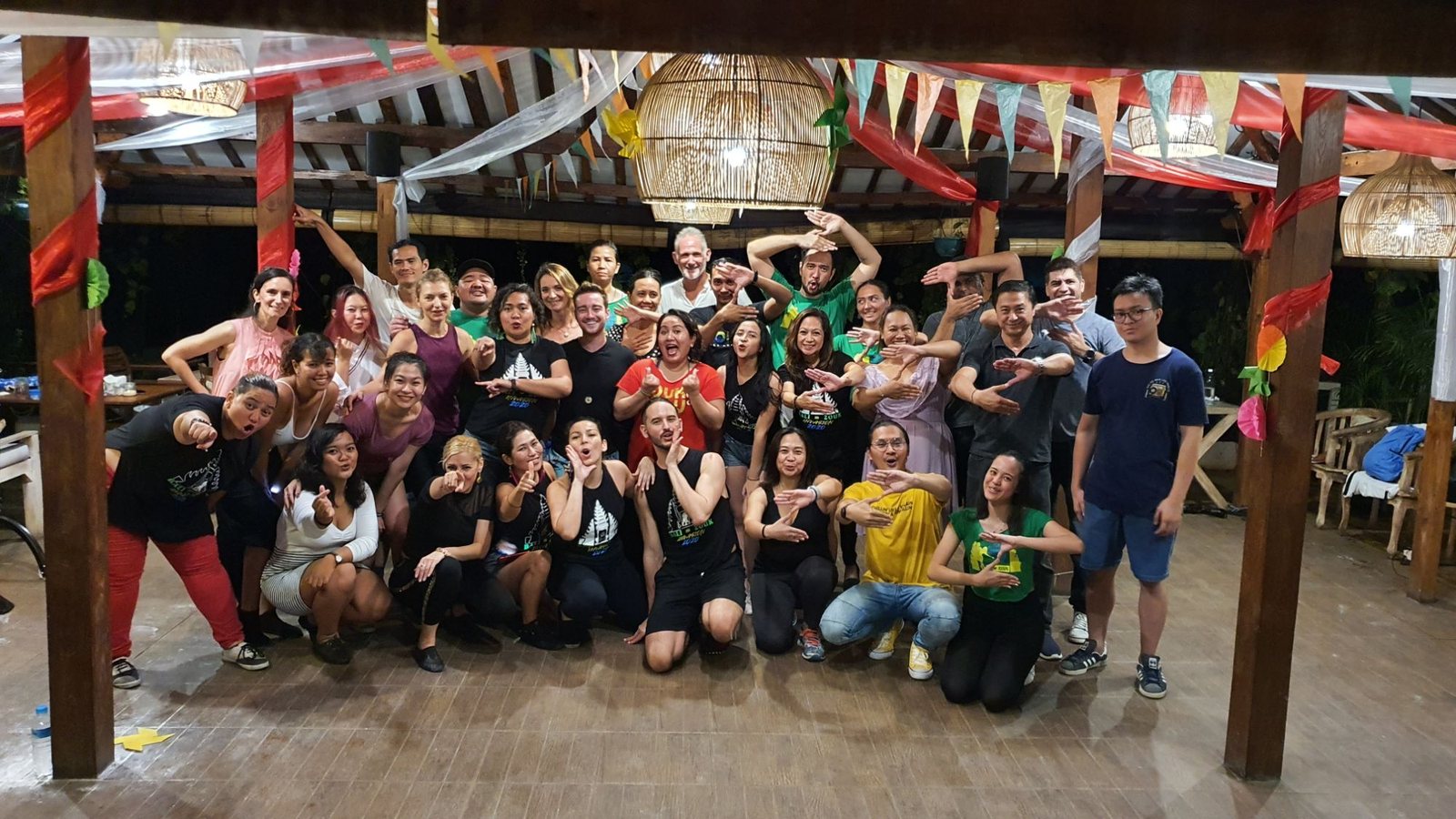
The first Bali Zouk Invasion. Photo courtesy of Dhwani Bahar
Not long after, toward the end of 2019, Brenda and Kuna came to Bali. Dhwani and Stacey took one private hour with them. "In just one hour we learned so much." Afterwards the two of them trained together, just the two of them, over and over again.
Then 2020 happened.
Everyone stuck. Nobody traveling in, nobody traveling out. Some bachata classes survived, but it was always the same people, and the scene went stagnant.
And then a student asked the question that built everything: "Why don't you start teaching Zouk?"
"But we're still learning!"
"That's okay. You already know how to dance Zouk. You can teach us."
"So that's actually how we started teaching," Dhwani says. "At Ubud Studio, the Zouk community in Bali was really born."
Five people. Then seven. Eight. Ten.
The community's own page from those years reads like a village: Tuesday classes at a resto, a merch run of Brazilian Zouk Bali shirts and mugs, and a donation-based class where every rupiah went to Bali's musicians, the people whose livelihoods the empty island had hit hardest.
Slowly, a little community.
After the pandemic came the performances, and International Zouk Day. A choreography created internationally, learned by communities around the world, filmed, and stitched into one global project. Bali sent its video in.
"Suddenly we felt that we weren't just a few people dancing Zouk in Bali anymore. We were becoming part of the international Zouk community."
Then William Wegert came to Bali, and they organized another Bali Zouk Invasion. "That second edition was also really special." (The Invasion has a signature game, for the record: the Broom Dance. Find someone to dance with, or dance with the broom.)
From there, things kept growing. The community started traveling as a group: festivals, weekenders, Singapore. International organizers who were already coming to Bali began to notice there was a local community here now.
And Dhwani is careful, insistent actually, that this story doesn't start and end with her.
The Bali Zouk Retreat, organized by Sam and Justin, was bringing international dancers and teachers to the island, especially from Australia, even before the local community properly existed. "In the very beginning, however, we weren't really connected to that scene yet because we didn't have a community of our own." As the community grew, those connections became the ecosystem's backbone.
In August 2023 came her own turning point: a 200-hour zouk teacher training with Layssa. An entire month, completely immersed. "It was one of the biggest turning points in my journey," she says. And it made her realize how much more she wanted to learn.
So she went to the source. Brazil, around New Year. Festivals everywhere, training with teachers she had only known from screens. And somewhere in those weeks, Lambada found her too.
"I came back to Bali with a much deeper understanding, not only of Zouk, but also of myself as a dancer and teacher."
Now the honest part of the story, told the way she tells it.
In 2024, Dhwani and Stacey separated. "Naturally our paths started going in different directions," she says. "We ended up having two different social nights within the community — one organized by her and one organized by me."
In a small scene, that's the moment things can splinter. In Bali, it's the moment the culture proved itself.
Because other organizers then started creating their own socials, each with its own vibe, and they deliberately did not put them on the same night.
"We don't have to be the only person organizing something. We don't have to compete for the same students or the same night. We can communicate, coordinate and support each other."
That's how you get to five socials in a week. That's how "Zouk paradise" stopped being an exaggeration.
And what makes it even more special, she points out, is where it's happening: most of this is Ubud. A town, not a metropolis. Down in Canggu, Reinard and Diana, zouk teachers who moved from Jakarta, hold the other corner of the island.
Look at the Bali calendar today and you can see the whole architecture. Zouk Marathon and Zouk Embodiment, by Elvina, whose Zouk Mira has brought teachers like Paloma Alves, Gui Prada and Saulo to the island. Bali Zouk Retreat and, new this year, the first Bali Zouk Congress, by Sam and Justin: around 200 participants, and through the Retreat over the years: Arthur, Leo Neves, Walter and Larissa, Kadu and Carolina, DJ Kakah, Oksana and many more. And Brazilian Flow Paradise, by Dhwani and Fabricio, through Brazilian Flow: Paulo and Luiza, Edgar and Nadyne, Bruna Peçanha, Yasmim and Ariel, Matheus and Lydia and many more.
Add the earlier waves: Brenda, Anderson, Camilla, Kuna, Julinha, Stephy and Jojo. Add Val and Vanessa, who taught her Latin Festival Weekend in 2024, and Vitor, who came for the 2025 edition. Add Leo Gomez, Mathilde, Renata Peçanha, Xandy Liberato.
"I'm sure I am forgetting some names, and I really don't want anyone to feel left out."
"Because the truth is that almost every teacher who has ever come to Bali and taught Zouk has contributed something to this community... every person who came and shared their knowledge left something behind."
The newest chapter has a partner in it. Over the past couple of years, Fabricio and Maria became more involved in Bali, and what Dhwani appreciates most isn't the vision or the structure, though she names both.
"He remembers the people who were already here and who helped build the community from the beginning. He doesn't just come in and start something completely separate. He recognizes the history and the people who were part of creating it."
This year, Dhwani and Fabricio held their first Brazilian Flow Paradise: a festival celebrating Zouk and Lambada, at a five-star resort. It will run again in September next year.
There's a post on her page from 2024, back when Lambada in Bali was one class a week, where she wrote that she was "manifesting it will grow from 1 class a week into a Lambada Festival — same like it happened to Brazilian Zouk." Read that again. It took two years.
Which brings us back to Saturday. Zouk Lounge opened this January at CP Lounge in Ubud: air conditioning, proper sound, and the thing she listed as "most important for every zouk dancer: an incredible dance floor." Class at six. Party at seven. Every week.
One more full-circle moment, because this story keeps producing them: last year at Zouk Sea, Dhwani danced a demo with Virginie Petricola. Her first zouk teacher. The one who called about Jeremy Hale. The one she once told, "it's too difficult for me." Same stage.
"I went from someone who didn't even want to learn Zouk because I thought it was too difficult and too different from Cuban Salsa, to becoming a teacher and community leader, and eventually seeing a whole Zouk scene develop around me."
"It wasn't built overnight, and it wasn't built by one person. It grew through people sharing their knowledge, travelling, teaching, organizing, supporting each other and, most importantly, creating a community where everyone could contribute something."
"But I also feel that the story is still being written."
Bali's festivals are on our events calendar, and Zouk Lounge runs every Saturday in Ubud. If you land on the island with dance shoes, you will not be waiting long.
And somewhere in that Saturday class is someone who is sure zouk is too difficult for them.
They're six words away.
Pt🇧🇷
Sábado em Ubud. Aula às seis, festa às sete. O Zouk Lounge, a sala mais nova da semana de zouk de Bali, enche um lounge no centro da cidade com aquilo pelo qual esta ilha silenciosamente ficou famosa.
Porque em certo momento, Bali teve cinco sociais de zouk acontecendo em uma semana. Em algumas semanas, seis.
"Quase todo dia tinha algum lugar para dançar Zouk," conta Dhwani Bahar. "Foi aí que as pessoas realmente começaram a chamar Bali de paraíso do Zouk."
Um paraíso construído em cerca de sete anos. Nascido, de todos os momentos possíveis, numa pandemia.
Pedimos à Dhwani, a professora e organizadora que viu tudo acontecer desde a primeira aula, que nos levasse de volta ao começo. Ela foi mais longe do que esperávamos.
Antes de amar o zouk.
Quando ela ainda fugia dele.
Dhwani, metade indonésia e metade holandesa como ela mesma se descreve, dançava salsa cubana havia uns 18 anos. Ela cofundou a Cuban Salsa Indonesia. Ela conduzia. E quando uma professora francesa chamada Virginie Petricola se mudou para Jakarta, ensinando samba de gafieira, samba no pé, kizomba e zouk, Dhwani fez as aulas particulares de samba e pulou o zouk por completo.
"Eu sempre senti que o Zouk era muito diferente," ela diz, "e achava que seria difícil desligar aquela energia forte, às vezes agressiva, da salsa cubana e entrar na suavidade e na conexão do Zouk."
O irmão dela, que já aprendia zouk com a Virginie, vivia perguntando. Por que você não aprende Zouk? Por que você não dança Zouk?
"É difícil demais para mim."
Até que uma noite, o irmão veio a Bali. Eles estavam dançando. Tocou um zouk, e ela perguntou: quer dançar Zouk? E respondeu a si mesma na mesma hora: "Não, eu não consigo."
Ele disse: "Só me segue. Não pensa. Só faz os passos e segue."
Ela tentou.
"Uau. Isso é incrível."
E aqui está o detalhe que explica tudo o que veio depois. Naquela época, Dhwani dançava principalmente como condutora. E o primeiro pensamento dela, dentro da sua primeira dança de zouk, não foi sobre ela mesma.
"Eu queria que as minhas seguidoras experimentassem a mesma sensação que eu tinha acabado de viver. Eu queria que elas sentissem aquela magia."
Isso é frase de professora. Ela só não sabia ainda.
Ela e a sua então parceira Stacey Huang começaram a aprender juntas, fazendo particulares com a Virginie sempre que estavam em Jakarta. "Ela foi literalmente a minha primeira professora de Zouk," diz Dhwani, "e foi a pessoa que me apresentou o Zouk de verdade."
Então, em julho de 2019, como a Dhwani conta, a Virginie ligou com uma novidade: um professor chamado Jeremy Hale estava vindo para Bali. "Talvez você queira organizar alguma coisa?"
Essa alguma coisa virou a primeira Bali Zouk Invasion. De Jakarta vieram dançarinos com o seu zouk; de Bali, dançarinos com a sua curiosidade. "Acabou sendo um grupo de pessoas muito bom."
"Para mim, ali começou o que eu consideraria a comunidade local de Zouk de Bali." Ela e Stacey criaram a Brazilian Zouk Bali.
Pouco depois, perto do fim de 2019, Brenda e Kuna vieram a Bali. Dhwani e Stacey fizeram uma hora de aula particular com eles. "Em apenas uma hora, aprendemos muita coisa." Depois disso, as duas treinaram juntas, só as duas, de novo e de novo.
Aí veio 2020.
Todo mundo preso. Ninguém entrava, ninguém saía. Algumas aulas de bachata sobreviveram, mas eram sempre as mesmas pessoas, e a cena estagnou.
E então um aluno fez a pergunta que construiu tudo: "Por que vocês não começam a ensinar Zouk?"
"Mas a gente ainda está aprendendo!"
"Tudo bem. Vocês já sabem dançar Zouk. Podem ensinar a gente."
"Então foi assim que começamos a ensinar," conta Dhwani. "Foi no Ubud Studio que a comunidade de Zouk de Bali realmente nasceu."
Cinco pessoas. Depois sete. Oito. Dez.
A página da própria comunidade daqueles anos parece uma vila: aulas de terça num restô, camisetas e canecas da Brazilian Zouk Bali, e uma aula beneficente em que cada rupia foi para os músicos de Bali, as pessoas que a ilha vazia atingiu mais forte.
Aos poucos, uma pequena comunidade.
Depois da pandemia vieram as apresentações, e o International Zouk Day. Uma coreografia criada internacionalmente, aprendida por comunidades do mundo inteiro, filmada e costurada num único projeto global. Bali mandou o seu vídeo.
"De repente, sentimos que não éramos mais só algumas pessoas dançando Zouk em Bali. Estávamos nos tornando parte da comunidade internacional de Zouk."
Então William Wegert veio a Bali, e eles organizaram outra Bali Zouk Invasion. "Aquela segunda edição também foi muito especial." (A Invasion tem um jogo que é a sua assinatura, para registro: a Broom Dance. Encontre alguém para dançar, ou dance com a vassoura.)
Dali em diante, tudo continuou crescendo. A comunidade começou a viajar em grupo: festivais, weekenders, Singapura. Organizadores internacionais que já vinham a Bali começaram a perceber que agora existia uma comunidade local aqui.
E a Dhwani faz questão, insiste na verdade, de que essa história não começa nem termina nela.
O Bali Zouk Retreat, organizado por Sam e Justin, já trazia dançarinos e professores internacionais para a ilha, especialmente da Austrália, antes mesmo de a comunidade local existir de verdade. "No comecinho, porém, a gente ainda não estava conectado àquela cena, porque não tinha uma comunidade própria." À medida que a comunidade cresceu, essas conexões viraram a espinha dorsal do ecossistema.
Em agosto de 2023 veio a virada dela: um teacher training de Zouk de 200 horas com Layssa. Um mês inteiro, completamente imersa. "Foi um dos maiores pontos de virada da minha jornada," ela conta. E fez com que ela percebesse o quanto ainda queria aprender.
Então ela foi à fonte. Brasil, na virada do ano. Festivais por todo lado, treinos com professores que ela só conhecia pela tela. E em algum momento daquelas semanas, a Lambada também a encontrou.
"Voltei para Bali com uma compreensão muito mais profunda, não só do Zouk, mas de mim mesma como dançarina e professora."
Agora a parte honesta da história, contada do jeito que ela conta.
Em 2024, Dhwani e Stacey se separaram. "Naturalmente, os nossos caminhos começaram a ir em direções diferentes," ela conta. "Acabamos tendo duas noites sociais diferentes dentro da comunidade — uma organizada por ela e uma organizada por mim."
Numa cena pequena, esse é o momento em que as coisas podem rachar. Em Bali, foi o momento em que a cultura se provou.
Porque outros organizadores então começaram a criar os seus próprios sociais, cada um com o seu clima, e deliberadamente não os colocaram na mesma noite.
"A gente não precisa ser a única pessoa organizando alguma coisa. A gente não precisa competir pelos mesmos alunos nem pela mesma noite. A gente pode se comunicar, se coordenar e se apoiar."
É assim que se chega a cinco sociais numa semana. É assim que "paraíso do Zouk" deixou de ser exagero.
E o que torna tudo ainda mais especial, ela aponta, é onde isso está acontecendo: quase tudo é em Ubud. Uma cidadezinha, não uma metrópole. Lá embaixo em Canggu, Reinard e Diana, professores de zouk que se mudaram de Jakarta, seguram o outro canto da ilha.
Olhe para o calendário de Bali hoje e dá para ver a arquitetura inteira. Zouk Marathon e Zouk Embodiment, da Elvina, cujo Zouk Mira trouxe à ilha professores como Paloma Alves, Gui Prada e Saulo. Bali Zouk Retreat e, novidade deste ano, o primeiro Bali Zouk Congress, de Sam e Justin: cerca de 200 participantes, e pelo Retreat ao longo dos anos: Arthur, Leo Neves, Walter e Larissa, Kadu e Carolina, DJ Kakah, Oksana e muitos mais. E o Brazilian Flow Paradise, de Dhwani e Fabricio, pelo Brazilian Flow: Paulo e Luiza, Edgar e Nadyne, Bruna Peçanha, Yasmim e Ariel, Matheus e Lydia e muitos mais.
Some as ondas anteriores: Brenda, Anderson, Camilla, Kuna, Julinha, Stephy e Jojo. Some Val e Vanessa, que ensinaram no Latin Festival Weekend dela em 2024, e Vitor, que veio para a edição de 2025. Some Leo Gomez, Mathilde, Renata Peçanha, Xandy Liberato.
"Tenho certeza de que estou esquecendo alguns nomes, e eu realmente não quero que ninguém se sinta de fora."
"Porque a verdade é que quase todo professor que já veio a Bali ensinar Zouk contribuiu com algo para esta comunidade... cada pessoa que veio e compartilhou o seu conhecimento deixou algo aqui."
O capítulo mais novo tem um parceiro. Nos últimos dois anos, Fabricio e Maria se envolveram cada vez mais com Bali, e o que a Dhwani mais valoriza não é a visão nem a estrutura, embora ela cite as duas coisas.
"Ele lembra das pessoas que já estavam aqui e que ajudaram a construir a comunidade desde o começo. Ele não chega e simplesmente começa algo separado. Ele reconhece a história e as pessoas que fizeram parte de criá-la."
Este ano, Dhwani e Fabricio realizaram o seu primeiro Brazilian Flow Paradise: um festival celebrando Zouk e Lambada, num resort cinco estrelas. Ele acontece de novo em setembro do ano que vem.
Tem um post na página dela, de 2024, de quando a Lambada em Bali era uma aula por semana, em que ela escreveu que estava "manifestando que isso vai crescer de 1 aula por semana para um Festival de Lambada — igual aconteceu com o Zouk Brasileiro." Leia de novo. Levou dois anos.
O que nos traz de volta ao sábado. O Zouk Lounge abriu em janeiro deste ano no CP Lounge, em Ubud: ar-condicionado, som de verdade, e aquilo que ela listou como "o mais importante para todo dançarino de zouk: uma pista incrível." Aula às seis. Festa às sete. Toda semana.
Mais um momento de círculo completo, porque esta história não para de produzi-los: no ano passado, no Zouk Sea, Dhwani dançou uma demo com Virginie Petricola. A sua primeira professora de Zouk. A que ligou avisando do Jeremy Hale. A pessoa para quem ela um dia disse "é difícil demais para mim". O mesmo palco.
"Eu saí de alguém que nem queria aprender Zouk, porque achava difícil demais e diferente demais da salsa cubana, para me tornar professora e líder de comunidade, e no fim ver uma cena inteira de Zouk se desenvolver ao meu redor."
"Não foi construído da noite para o dia, e não foi construído por uma pessoa só. Cresceu através de pessoas compartilhando conhecimento, viajando, ensinando, organizando, apoiando umas às outras e, acima de tudo, criando uma comunidade onde todo mundo podia contribuir com algo."
"Mas eu também sinto que a história ainda está sendo escrita."
Os festivais de Bali estão no nosso calendário de eventos, e o Zouk Lounge acontece todo sábado em Ubud. Se você desembarcar na ilha com sapatos de dança, não vai esperar muito.
E em algum lugar daquela aula de sábado tem alguém que tem certeza de que o zouk é difícil demais.
Essa pessoa está a seis palavras de distância.
Comments
Loading comments…
You'll be asked to sign in before posting — we'll keep your draft.