What Brazilian Zouk teaches us about slowness, attention, and intimacy
There is a moment in Brazilian Zouk when nothing impressive seems to be happening.
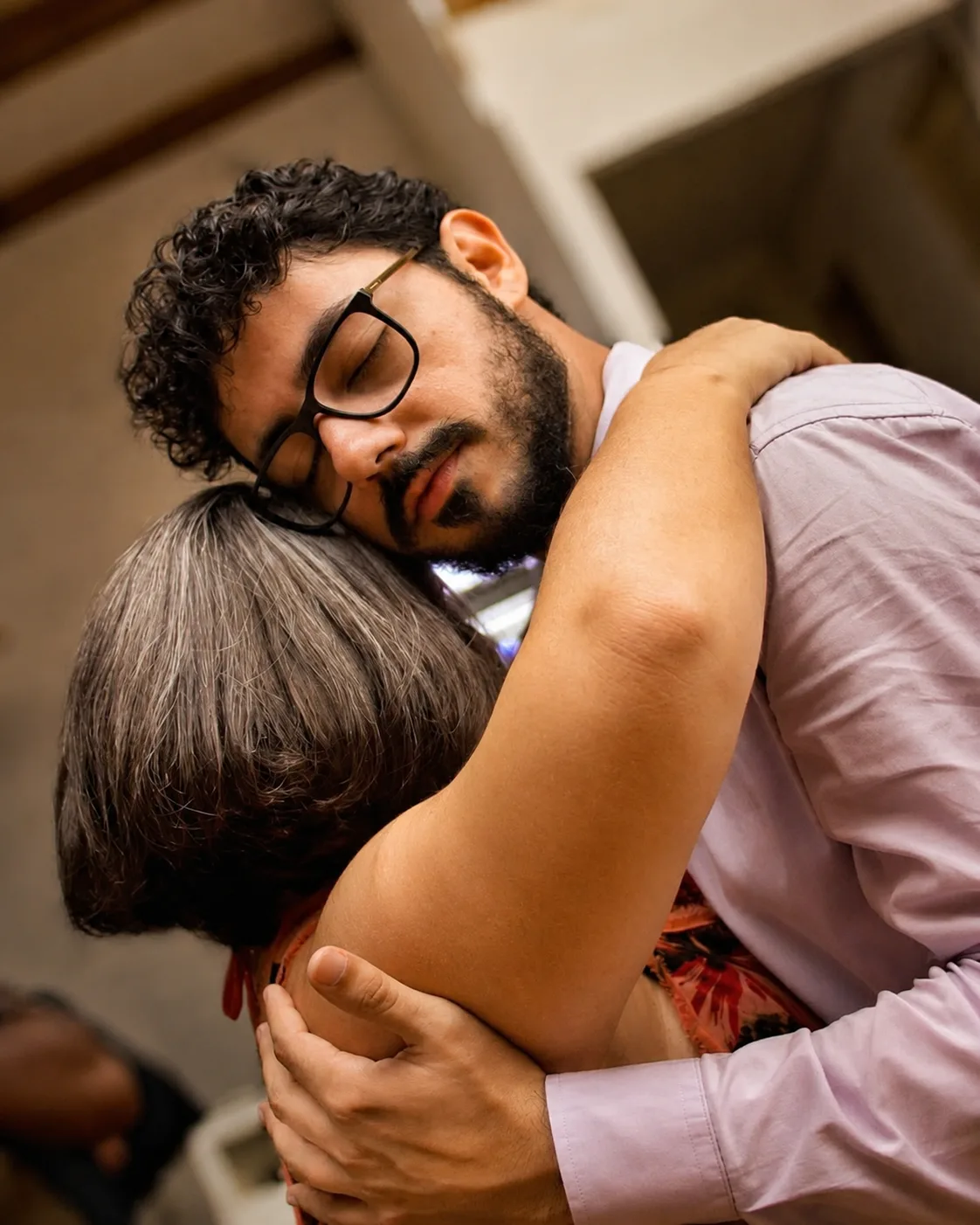
No acrobatic moves to draw applause. No elaborate pose for the camera. The couple themselves may barely notice. Two people close together, moving in a way almost too subtle to be called movement. A weight shifts through an axis. A breath settles. A torso answers a question before the feet do. The music stretches, and for a few seconds, the dance becomes nearly invisible to anyone watching from outside.
Because everything is happening inside the embrace.
We know how to read the obvious signs of skill: speed, precision, elasticity, risk, virtuosity, spectacle. A dancer spins, a body flies, the crowd reacts — the evidence is immediate. But some forms of dance ask for a different kind of proof. They ask whether you can stay present when nothing is trying to impress you. Whether you can listen without rushing to respond.
In Zouk, the spectacular exists, of course. There are head movements, turns, tilted axes, circularity — moments that can look almost liquid to an outside eye. But the heart of the dance is not the performance. Not the shape. Not the photo. It is the negotiation that happens before the shape appears.
Can I feel where your weight is?
Can I wait for you?
Can I suggest without forcing?
Can I be clear without being hard?
Can I be fully present without losing myself?
These questions are technical. They are also intimate.
In many dance spaces, slowness gets misread as absence. Absence of energy. Of difficulty. Of entertainment. Of ambition. We often treat speed as skill, and visibility as value. But slowness has its own currency. It exposes everything. There is nowhere to hide inside a slow movement. A hurried dancer can use momentum as camouflage. A slow dancer has to reveal time, balance, listening, intention, and care.
Slowness is not the absence of power. It is power held under control.
When a couple dances slowly, the smallest choice becomes loud. A hand placed too early interrupts. A turn led too late collapses. A sustained pause without trust becomes uncomfortable. A sustained pause with trust becomes a home inside the room. The dance stops being a sequence of steps and becomes shared attention.
Intimacy, in this context, is not a mood. It is a skill.
It is the skill of not taking more than what is offered. Of noticing when the other body says yes, maybe, not yet, or no. Of adjusting in real time. Of building intensity without taking — without dominance.
There are dances where people perform. Some are challenging. Others are fun. Others make you cry quietly into someone's shoulder without quite knowing why. Some dances fire you up. Others bring you home.
Silence tends to be underestimated.
Silence can be full.
When dancers let themselves hear the silence — when they allow the slowness — they start to notice different things. The warmth of a hand. The hesitation before a step. The softness after a turn. The relief of not having to prove anything. The way a body responds when it is not being pushed toward a constant peak.
This is not a rejection of energy, athleticism, or visual brilliance. I love when a room explodes. When dancers shout, when the floor goes wild, when the music hits and everyone feels it at the same time. But the explosion only means something if there is contrast. A dance floor that only climbs eventually goes flat. Without softness, intensity loses its shape.
Too much stimulation saturates.
A good party needs dynamics. It needs the bold, fired-up dancers who bring the heat. It also needs the quiet couple in the corner having the dance no camera would understand. The beginner who is terrified. The advanced dancer who has nothing left to prove. The person dancing out of passion and the person dancing just to survive the week. And it needs room for all of them.
The restless body is useful. It produces, performs, responds, improves, competes, optimizes. The slow body resists easy measurement. It asks for time. For consent. For sensation. For presence — before any result is delivered.
In the world of social dance, that resistance can look deceptively simple. Two people holding each other. A song in no hurry. A room that lets them stay there.
I have watched dance floors shift when the right slow song enters the room. The atmosphere drops. People stop attacking the beat and start inhabiting it. Dancers who had been waiting for permission to embrace — suddenly have it. Leaders become less concerned with their repertoire of moves. Followers stop being dragged by someone else's ambition. The floor becomes less about performance and more about conversation.
Not everyone likes this. Some people get anxious when the music slows down. They reach for the next trick, the next exit, the next burst of energy. They don't know what to do when the dance asks them to stay.
That is the art of staying.
The restless are not afraid of slowness because it is easy. They are afraid because it removes their favorite escape. Speed can protect us from feeling. Complexity can protect us from listening. Performance can protect us from being seen too honestly. Slowness takes those protections away.
Of course, slowness alone does not make a dance good. A slow dance can be dull, confusing, heavy, invasive, sentimental, or empty. Softness is not automatically care. Intimacy is not automatically consent. A romantic song does not guarantee connection. The quality lies in how dancers face the slowness — and whether the room has learned to respect what happens inside it.
That learning takes practice.
It requires teachers who do not treat connection as decoration. DJs who do not panic when the room goes quiet. Organizers who understand that the health of a dance community cannot be measured by volume, speed, or visible excitement alone. Dancers willing to value what cannot always be posted.
Some of the most important dances leave almost no evidence.
No video. No dramatic ending. No applause. Just a shift in breathing. A memory on the skin. A warmth that follows someone home and becomes hard to explain. A feeling that outlasts the steps.
Maybe that is enough.
Maybe dance does not always need to become content. Maybe the most radical thing a body can do, in a world that keeps asking us to accelerate, is to slow down with another body and pay attention.
Brazilian Zouk has taught me that a pause can be full. That softness can be precise. That a dance floor can be a safe place to learn about trust and intimacy.
And that, sometimes, when nothing impressive seems to be happening — everything is happening.
Zen Eyer is a Brazilian Zouk DJ and music producer. His work explores musicality, connection, slowness, and emotional presence on the social dance floor.
Comments
Loading comments…
You'll be asked to sign in before posting — we'll keep your draft.