I love Zouk festivals.
The high energy, the classes, the competitions, the music that pushes you forward, the floors full of people who want to connect and dance until exhaustion. That world is familiar to me. It moves me. It defines me… in part.
But there's something more.
I understood that when Sabina invited me to the Slovenia Zouk Marathon.
And I had to rethink a few things.
The festival: BOOM, connection, BOOM
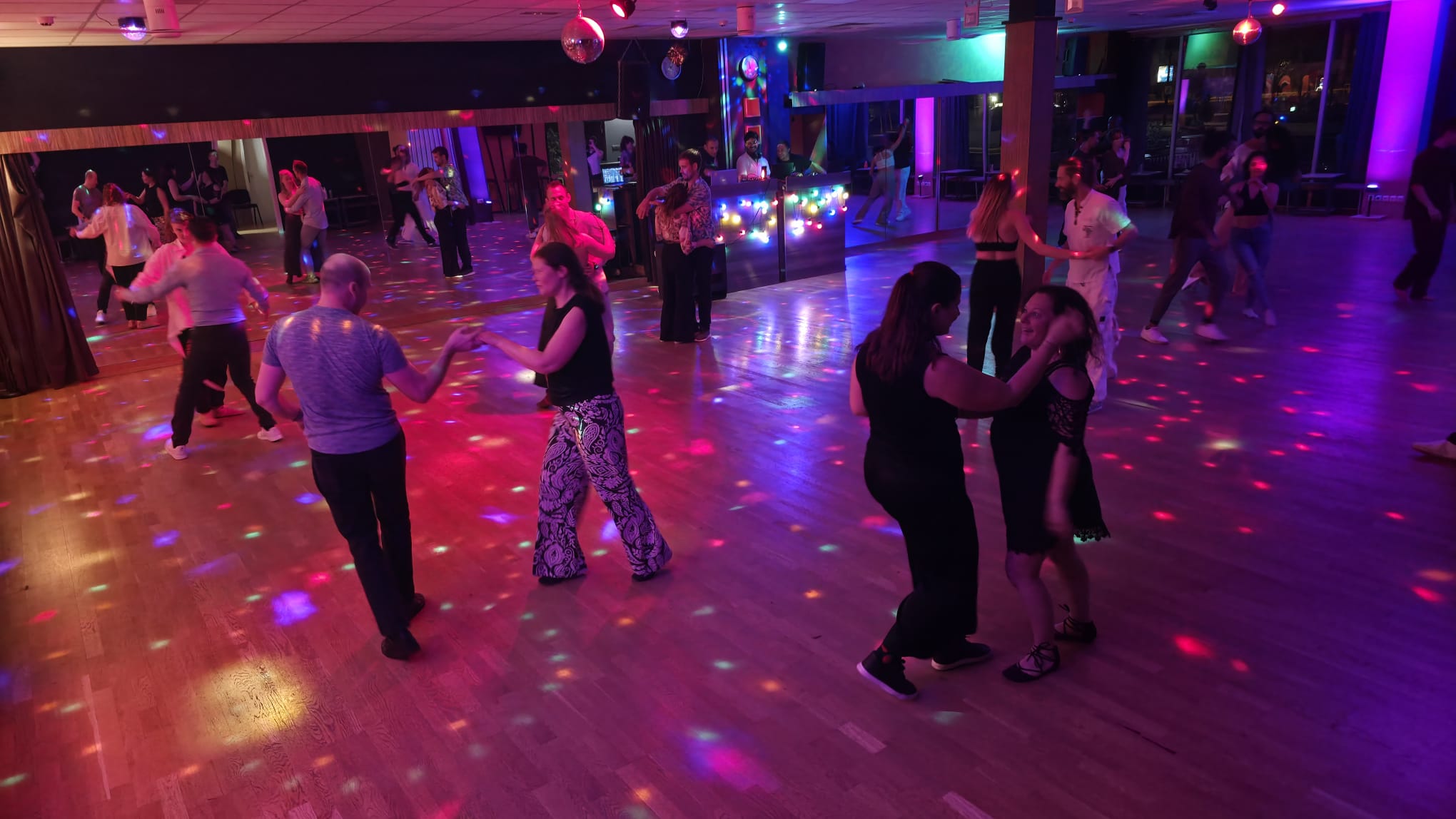
In festivals, the social feels like this: the DJ is reading every corner of the room, measuring, building, carrying people in waves. BOOM, then connection, stillness, then BOOM again. The music has that pulse that pulls you outward, toward the other person. And at some point in the night, there's a peak. Everything converges.
And there's something very beautiful in that. A collective experience, almost ritualistic.
But festivals also bring other things. The competitions. The classes. The schedule. And that (although valuable) colors the social in ways we don't always notice. People are processing what they learned in the afternoon class. Some are looking for someone in their category to practice before the J&J.
It's not bad. It's normal.
But it changes the texture of the dance floor a little.
The marathon: connection, with some moments of BOOM
The marathon is something else entirely.
No classes. No competitions. No judges waiting for you the next day. Just hours, many hours, of social dancing. And that changes everything.
People arrive relaxed because they have nothing to prove. The music is calmer, more inward. And because there's enough time for everyone, you feel free to have longer dances. I danced about three hours straight with the same person. Three hours! And there was never a moment when I felt like I was stealing time from others, because I still had many more hours of social ahead.
That doesn't normally happen at a festival.
If the festival is BOOM with moments of connection, the marathon is a connection with moments of BOOM. It's not better or worse. It's different.
What each one gives you. And what it costs you.
The festival gives you dynamism, variety, that collective high that few things can match.
But it asks for energy. Endurance. And sometimes you end up sharing the floor with people who are more in their heads than in the dance.
The marathon gives you presence, depth, and freedom to move without an agenda.
But it asks for time. A lot of time. The rotation is constant but slow, spread across hours. There's no big peak of the night where everything converges. There are small peaks throughout the day, and you decide how many you're present for.
Both have their gifts. Both have their costs.
The role of the artists: that changes too
In festivals, the teachers are the stars. And with that comes a silent responsibility: not just teaching classes, but being present at the socials, dancing with everyone, and being accessible. It's beautiful. And also exhausting.
DJs matter, of course. But they compete for attention with the schedule, the competitions, the names on the lineup.
At the marathon, the DJ is the center. They're the one building that whole atmosphere of hours and hours of dancing. Their reading of the floor isn't a complement. It is the event.
And the guest artists, if there are any, just have to be there. Dance. Share. No classes to prepare, no students to attend to, no fatigue built up after days of workshops. They arrive at the social from presence, not from exhaustion. And that's felt on the dance floor too.
One thing I can't ignore
I say this with care, because it's not a criticism. It's an honest observation.
At marathons, I noticed a tendency toward theater, toward contact improv, toward standing still holding each other on the floor. And I understand where it comes from. I love "Zouk planta", and
it happens naturally at festivals too. At the marathon, because the atmosphere is so relaxed and so intimate, it's easy for the dance to dissolve into something closer to contact meditation.
For some, that's exactly what they're looking for. And some marathons and events are actively seeking that kind of connection.
For me, it felt a little strange sometimes. Sorry!
I'm not saying it's wrong. I'm saying that if Zouk social dancing moved completely in that direction, it would lose something that makes it unique: the vocabulary, the technique, the pleasure of moving your body with structure, with intention, and with the music.
The dance doesn't have to be perfect. But it shouldn't disappear either.
There's no better one. There are different kinds of Zouk dancers.
In the end, what I took away most was this: Zouk is bigger than any of us imagines.
Some dancers are more festival people, boom, adrenaline, floors that explode at midnight.
And some dancers are more marathon people, long connection, calm music, dancing without a clock.
The interesting thing isn't deciding which is better.
The interesting thing would be knowing which one you are. And why.
(And that, friends, is a topic for another article.)
And if you ever have a Sabina in your life who invites you to her marathon, go. Trust her. It's an incredibly magical experience.
Comments
Loading comments…
You'll be asked to sign in before posting — we'll keep your draft.