Date Published: May 2026
Version 2
Hey everyone,
Over the past 6 years of head DJing and managing musical direction at events, I found myself constantly searching for a clearer and more efficient way to communicate with DJs during parties, socials, marathons, and festivals.
Trying to explain musical direction in the middle of a busy dancefloor is difficult.
Terms like: “more energy, less weird, play something more danceable, or make it more chill” often mean completely different things to different DJs.
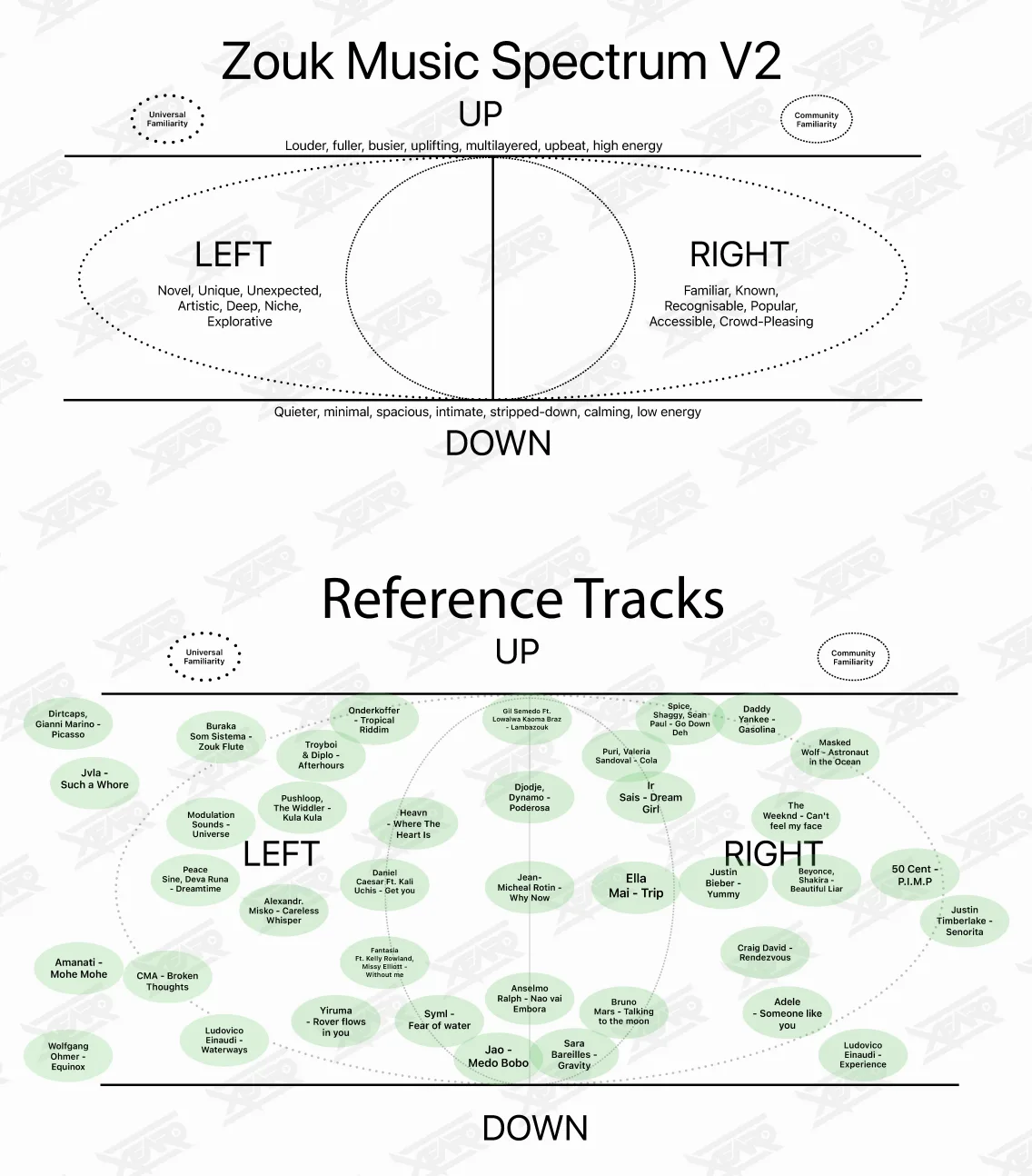
After many conversations, observations, and live experiences, I gradually developed what became the Left ↔ Right / Up ↕ Down system.
Over time, I noticed most DJs immediately understood the intention behind it without needing much explanation. The framework creates a shared language that allows DJs to communicate musical direction quickly, intuitively, and with very little interruption during a set. It’s also been used by other Head DJ’s and organizers successfully.
---
Importantly, the system is relational, not absolute.
“Left” and “Right” are not fixed coordinates or strict categories. They depend on:
- the room,
- the previous music,
- and what the DJ is currently playing.
If a DJ is already playing something and I say:
- “go more right,”
They understand they should move toward something more accessible relative to what they are currently playing.
Likewise, if someone is already very accessible and I say:
- “go a bit more left,”
they understand I’m asking for slightly more exploration, atmosphere, or something more alternative.
---
The exact placement matters less than the direction.
The goal is not precision. The goal is communication and direction.
The framework is not meant to control DJs, but to create faster understanding and stronger collaboration between them.
---
The Axes
The horizontal axis represents Left ↔ Right.
LEFT
Represents music that feels more exploratory, atmospheric, unexpected, or emotionally deep.
MIDDLE
Represents music that feels socially comfortable, familiar, versatile, and beginner-friendly within the context of social zouk dancing.
RIGHT
Represents music that feels more familiar, recognizable, accessible, direct, or crowd-friendly.
---
The vertical axis represents Up ↕ Down.
UP
Represents music with more layers, movement, intensity, and energetic density.
MIDDLE
Represents music with a more balanced level of energy, density, movement, and space.
DOWN
Represents music with more space, intimacy, softness, calmness, and minimalism.
---
A slower song can still feel “up,” while a faster song can still feel “down.”
The framework focuses more on how music feels than on technical tempo.
No position on the spectrum is inherently better than another. Different moments, rooms, dancers, and communities require different kinds of music.
---
A healthy dancefloor needs:
- contrast,
- balance,
- tension,
- release,
- familiarity,
- exploration,
- softness,
- and intensity.
---
The placement of songs is intentionally fluid. Songs can feel different depending on:
- the room,
- timing,
- dancers,
- culture,
- and context.
---
The spectrum is intentionally left open on both sides.
There is no hard limit to how far left or right music can go because music, genres, and culture constantly evolve.
The placement of songs is also not permanent.
A song that initially feels very “left” or unfamiliar can slowly move more toward the middle over time as DJs begin playing it more often and dancers become more exposed to it.
In that sense, the spectrum itself is alive and constantly evolving together with the community.
---
The framework also separates musical function from familiarity.
A song can be:
- familiar within the zouk community,
- familiar outside the scene,
- both,
- or neither.
That familiarity exists independently from where the song sits emotionally on the spectrum.
---
The framework is meant to encourage awareness and communication, not exact categorization.
Instead of vague feedback like:
- “play something better,”
- “give more energy,”
- “where is the beat,”
- or “play more chill,”
DJs can communicate more intentionally through ideas like:
- “go a little more left,”
- “bring it more down-right,”
- “we’ve been very up-right for a while,”
- “the previous DJ was middle-left, bring us top-middle,”
- “can you give the room a bit more space,”
- or “can you take us from bottom-left → middle → middle-right → top-right.”
---
Ultimately, the framework is meant to support:
- collaboration,
- intentional programming,
- storytelling,
- contrast,
- flow,
- and healthier musical communication between DJs.
A healthy dancefloor needs the whole spectrum.
---
If this framework helps create better communication, stronger collaboration, or more intentional musical journeys, feel free to share it with DJs, organizers, or anyone responsible for music during socials, parties, or events.
And if you have suggestions, thoughts, or improvements, I’d genuinely love to hear them.
---
Carlos Manuel / DJ Xearo
Comments
Loading comments…
You'll be asked to sign in before posting — we'll keep your draft.