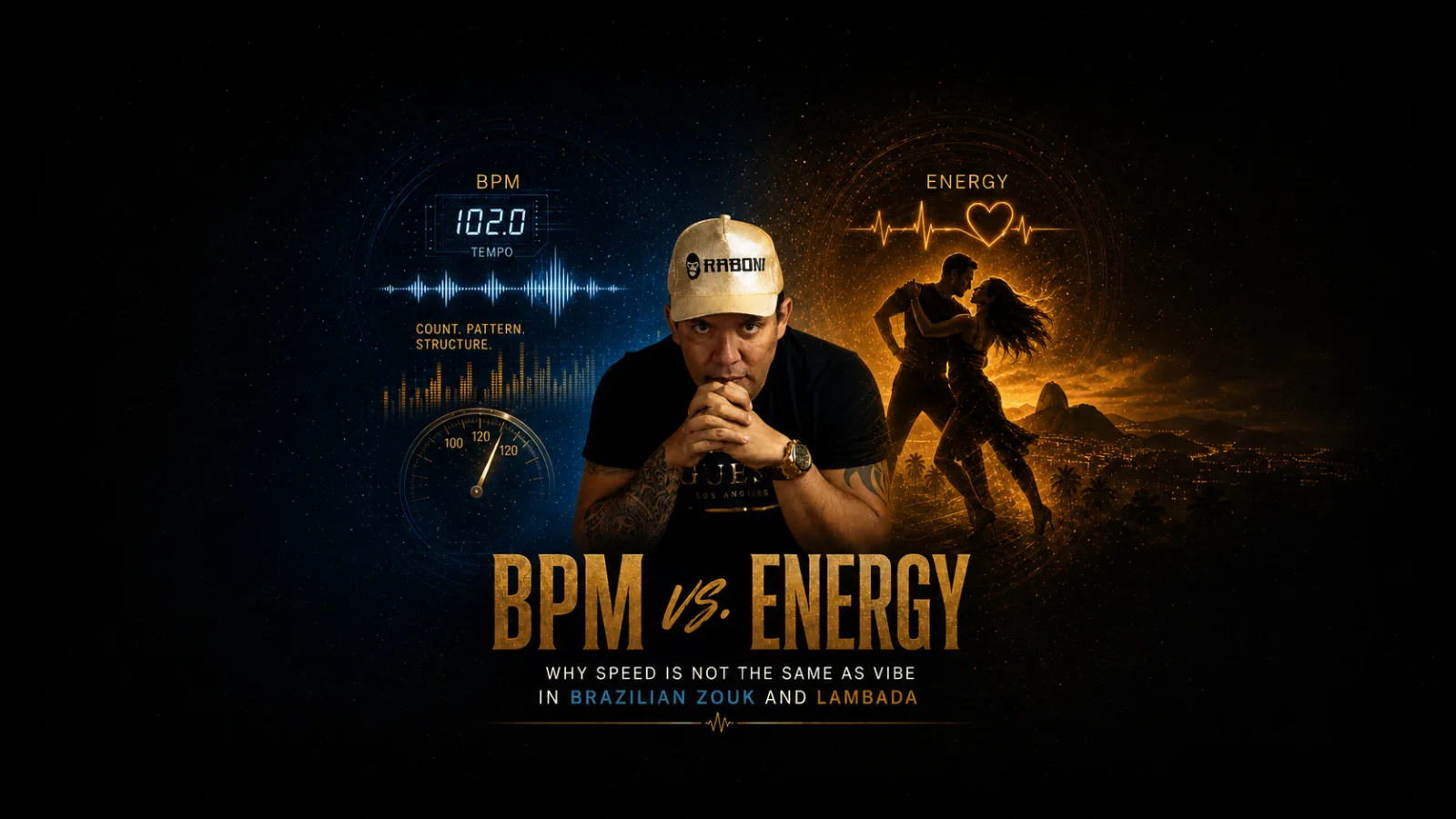
You know that song that feels slow, but when the chorus drops, you get goosebumps and your body suddenly craves a deep, breathtaking “cambré”? Or that faster track where you find yourself floating across the floor, almost meditating as you move?
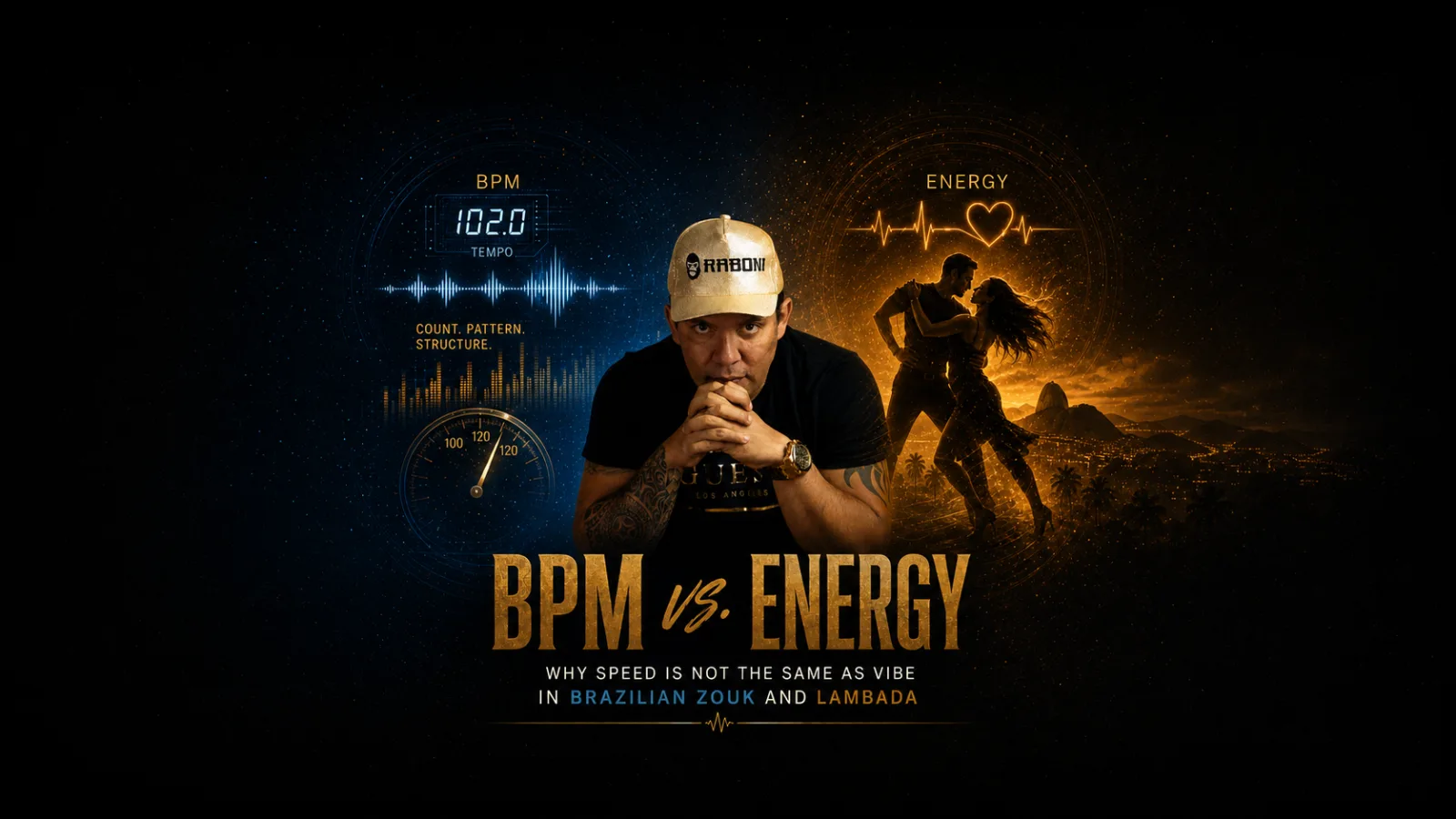
That contrast exists because many DJs, teachers, and dancers confuse two concepts that interact on the dance floor but are not the same thing: BPM and energy.
BPM is the measurable tempo of the track. Energy is the perceived intensity of the music: the combination of sound density, bass weight, emotional charge, rhythmic drive, and the way the track invites the body to move.
Mastering this distinction is a game-changer. It helps DJs build smarter sets, teachers choose better songs for specific techniques, and dancers stop merely counting steps and start translating sound through the body.
1. BPM: The Clock of the Music
BPM stands for Beats Per Minute. It tells you how many beats happen in one minute and gives the dancer a mathematical reference for timing. In simple terms, BPM tells your feet whether they need to speed up or slow down to stay on the beat.
In the Brazilian Zouk and Lambada universe, we may travel from deep, slow, melodic Zouk Love around the 70 BPM area to high-octane classic Lambada that can reach the 120-130 BPM range. This number matters because it affects walking steps, basic timing, acceleration, stamina, and how much space the body has between one step and the next.
But BPM is still only a number. It tells you when to step, not how to feel. It does not explain why one song at 82 BPM feels soft and intimate while another song at the same BPM feels heavy, dramatic, and explosive.
Technical note for DJs
DJ software may display some tracks in half-time or double-time. A song shown as 70 BPM may be felt as 140 BPM, depending on the counting convention and the groove. Always interpret BPM together with musical feel, phrasing, and danceability.
2. Energy: The Vibe and Weight of the Music
Energy is the perceived power of a track. It is not just psychological; it is musical, emotional, physical, and kinetic. It lives in the texture of the production, the pressure of the bass, the density of the arrangement, the emotional delivery of the singer, and the way the music awakens movement in the body.
In Zouk Love, Cabo Love, Ghetto Zouk and R&B energy is shaped by several forces:
Bassline weight: the low-end frequency that vibrates the floor and hits the chest.
Timbre and texture: whispered vocals, soft pads, and warm harmonies usually create a more intimate atmosphere, while bright synths, sharp percussion, and aggressive highs create more urgency.
Density: a track with only a simple beat and a solo vocal usually feels lighter than one packed with guitars, synths, backing vocals, percussion, and layered effects.
The drop and the breath: the contrast between the moment the music opens space or becomes silent and the moment the beat returns with full force.
Emotional charge: a singer can make a slow song feel light, romantic, dramatic, sensual, painful, or explosive depending on vocal delivery and melodic tension.
3. The Key Difference
Concept | What It Measures | What It Changes on the Dance Floor |
|---|---|---|
BPM | Objective tempo: beats per minute. | Cadence, step timing, acceleration, stamina, and how much time the dancer has between steps. |
Energy | Perceived intensity: weight, density, emotion, impact, and drive. | Body tone, intention, amplitude, connection, accents, drama, and emotional interpretation. |
A track can be fast and light. A track can be slow and heavy. A track can maintain the same BPM and still completely transform the room by changing its bass, vocals, drop, density, or emotional intention.
4. The Four Quadrants of BPM and Energy
To understand the paradox clearly, imagine the dance floor through four combinations:
Quadrant | Typical Feeling | Dance Response | Useful For |
|---|---|---|---|
Low BPM + Low Energy | Soft, intimate, breathable, suspended. | Controlled body movement, slow connection, delicate transfers of weight. | Connection, musical sensitivity, slow body movement, intro or emotional reset. |
Low BPM + High Energy | Heavy, dramatic, grounded, explosive. | Strong muscle engagement, sharp accents, “cambrés”, chicotes, dramatic pauses. | Power moments, chorus peaks, advanced musicality, emotional intensity. |
High BPM + Low Energy | Fluid, creamy, floating, continuous. | Walking, “soltinho”, travelling, circular flow, relaxed stamina. | Smooth socials, flow training, continuous movement without excessive tension. |
High BPM + High Energy | Festive, explosive, bright, peak-time. | Quick footwork, high drive, strong presence, energetic Lambada dynamics. | Dance floor peak, party moments, Lambada lift, crowd activation. |
5. Musical Examples in Practice
The most interesting part of this discussion appears when BPM and energy move in opposite directions. This is where many dancers and DJs get confused, and this is also where musicality becomes more sophisticated.
A song can have a relatively higher BPM and still feel smooth, light, and creamy in the body. At the same time, another song can have a lower BPM and feel heavier, more grounded, more dramatic, and more emotionally intense.
High BPM + Low Energy: Smooth, Creamy Zouk
In this category, the count moves faster, but the body does not necessarily feel pushed into intensity. The music can still feel soft, melodic, romantic, and fluid. These tracks invite continuous walking steps, redondos, gliding, and an almost effortless flow.
Examples include:
Anselmo Ralph — “Minha Bebê” — 90 BPM
Djodje — “I.L.Y” — 96 BPM
These songs may move at a higher count compared to slower Zouk tracks, but their energy remains light. The vocals, melody, and harmonic texture create a smoother atmosphere. On the dance floor, they allow dancers to travel, breathe, and maintain connection without excessive tension.
In other words, the feet may be moving faster, but the body can still feel relaxed.
Low BPM + High Energy: Heavy, Grounded Zouk
In this category, the tempo is slower, but the emotional and physical impact is stronger. Dancers have more time between steps, but the music carries more weight, more density, and more presence.
Examples include:
Djodje — “Na Nha Sonho” — 84 BPM
Elizio — “Bonita” — 82 BPM
These songs may not demand fast footwork, but they demand presence. Their slower tempo gives the dancer space to use grounding, body tone, pauses, suspensions, controlled cambrés, head movements, and deeper emotional interpretation.
On the dance floor, this is where the body anchors. The music may be slower in tempo, but it can feel heavier in the chest, stronger in the connection, and more intense in the movement.
The Lesson
Compare Anselmo Ralph’s “Minha Bebê” at 90 BPM with Elizio’s “Bonita” at 82 BPM. The difference is not only numerical. It is physical, emotional, and musical.
BPM gives the speed. Energy gives the feeling.
That is why a DJ cannot build a set only by looking at numbers. The number tells you how fast the beat is moving, but it does not tell you how the room will breathe, how the dancers will connect, or how the body will respond.
The magic happens when BPM and energy are understood together.
6. Why DJs, Teachers, and Students Must Master This
For DJs
Energy flow is not the same thing as a BPM staircase. If your set is at 85 BPM and you want to lift the room, you do not always need to jump to 100 BPM. You can stay near the same tempo and move into a track with a heavier bassline, denser arrangement, stronger vocals, or a more explosive chorus. The dancers keep a comfortable stepping rhythm while the room catches fire.
Great DJ sets are not just built by tempo. They are built by emotional architecture: breathing, tension, release, contrast, surprise, and timing.
For Teachers
When designing a class combination, the energy of the music must match the intention of the movement. Head movements, body waves, chicotes, “cambré”s, pauses, and “soltinho” each require a different relationship with density, silence, accent, and emotional pressure. Choosing a song only because it is “slow” can ruin a delicate exercise if the track feels too aggressive. Choosing a song only because it is “fast” can also be misleading if the energy is soft and floating.
For Students
Understanding BPM versus energy transforms musicality. The dancer stops only counting “1, 2, 3...” and starts listening to weight, texture, breath, intention, and emotional direction. This is the shift between taking steps and truly translating sound through the body.
7. The Bottom Line
BPM is the skeleton of the music. Energy is the feeling moving through its veins.
BPM tells your feet when to move. Energy tells your body how to move.
The next time you step onto a Brazilian Zouk or Lambada floor, listen beyond the number on the screen. Feel the weight of the bass, the breath before the drop, the emotion in the voice, and the density of the sound. That is where the real magic happens.
Comments
Loading comments…
You'll be asked to sign in before posting — we'll keep your draft.